
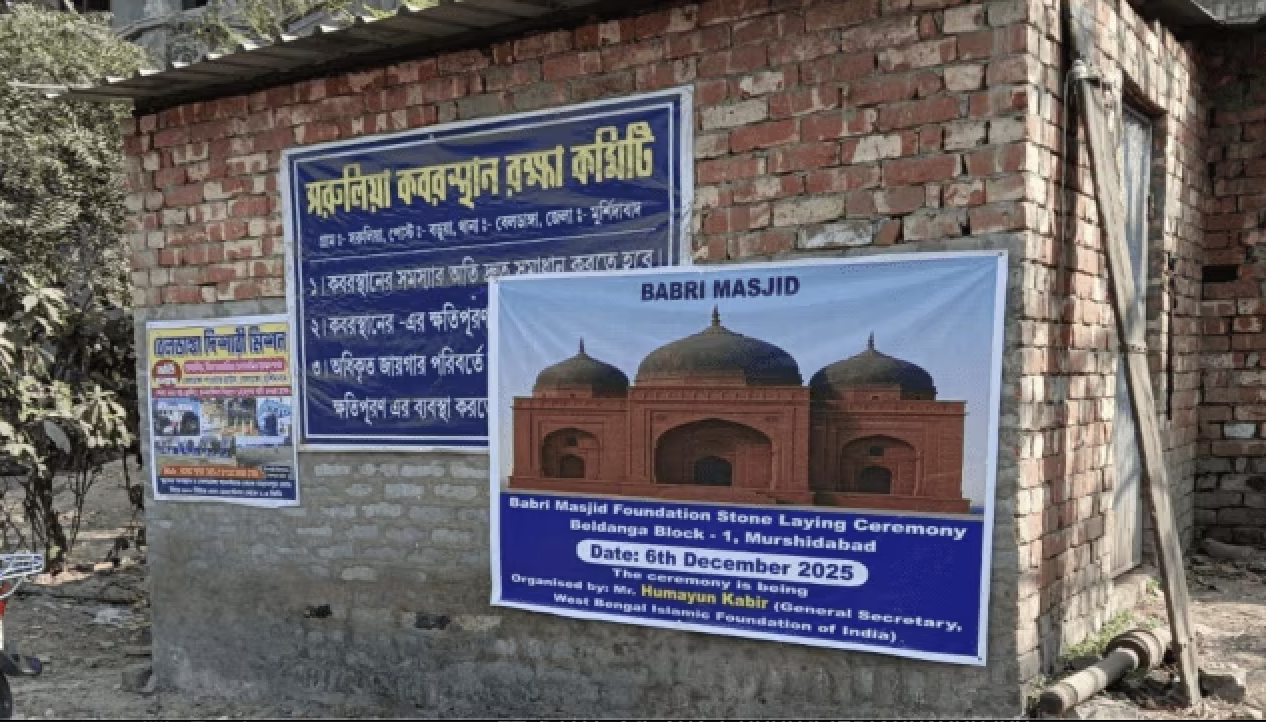
Hoardings, posters, and leaflets circulating across villages and towns in West Bengal’s Murshidabad district depict the Babri Masjid and call for laying its foundation stone on December 6 — 856 km from Ayodhya and 33 years after its demolition. The proposed structure has sparked a row in West Bengal months before Assembly polls in the state.
At the centre of the “revival” is ruling Trinamool Congress (TMC) Bharatpur MLA Humayun Kabir, who plans to lay the “foundation stone” of what he describes as a smaller version of the Babri Masjid in the district’s Beldanga block on December 6, the day in 1992 when the mosque in Ayodhya was brought down by Hindu kar sevaks. In response to Kabir’s remarks, two Hindu groups have formed trusts to begin construction of what they are saying are replicas of the Ayodhya Ram Mandir in the district.
With the ongoing Special Intensive Revision (SIR) of electoral rolls across the state — a key flashpoint between the Mamata Banerjee government and the Election Commission (EC) — and Assembly polls on the horizon, Murshidabad, which borders Bangladesh, is in focus. Banerjee herself is scheduled to visit Murshidabad on December 4.
Since the 2002 SIR, Murshidabad has seen a 87.65% rise in the number of voters. Other border districts have also seen an uptick with Uttar Dinajpur (105.49% increase in number of registered voters), Malda (94.58%), South-24 Parganas (83.30%), Jalpaiguri (82.3%), Cooch Behar (76.52%), North-24 Parganas (72.18%), Nadia (71.46%) and Dakshin Dinajpur (70.94%).
As December 6 approaches, despite some setbacks, Kabir, who is also the secretary of the newly formed West Bengal Islamic Foundation of India, remains determined to lay the foundation stone of the mosque.
This story was originally published in indianexpress.com. Read the full story here.