
By CJP Team
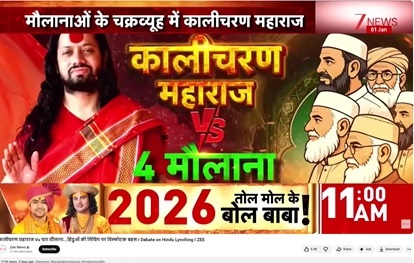
On January 20, the Citizens for Justice and Peace (CJP) approached the News Broadcasting and Digital Standards Authority (NBDSA) against Zee News over a January 1, 2026 prime-time broadcast that the CJP alleges was “a communalised televised spectacle designed to inflame anti-Muslim sentiment” and a “textbook violation” of broadcast ethics. The complaint was filed in relation to Zee News’ debate show titled “कालीचरण महाराज Vs चार मौलाना…हिंदुओं की लिंचिंग पर विस्फोटक बहस I Debate on Hindu Lynching I ZEE”.
According to CJP’s complaint, the show in question surrounded the tragic incidents of violence against Hindus in Bangladesh, which the program used as a pretext to incite communal tension within India. It is important to mention that while the professional identities of the Muslim panellists—including Islamic scholars and researchers—were acknowledged in the introductions, the channel systematically reduced them to a religious monolith by utilising the sensationalist and confrontational title “Kalicharan Maharaj Vs 4 Maulana.”
The complaint argues that the format, framing, selection of panellists, choice of questions, and on-screen graphics collectively abandoned journalistic neutrality and elevated unverified conspiracy-laden assertions into national discourse without editorial scrutiny. CJP has asserted that the show not only misrepresented facts regarding violence against Hindus in Bangladesh, but also used such incidents as a pretext to frame Indian Muslims as a civilisational threat.
From cross-border violence to domestic polarisation
According to the complaint, the broadcast opened by linking violence against Hindus in Bangladesh with the purported rise of “Islamist aggression” globally. However, instead of exploring geopolitical circumstances or international minority protections, the show allegedly shifted its focus toward a domestic communal binary. The choice to present the debate as “Kalicharan Maharaj vs 4 Maulana” formed the foundation of this shift, CJP states.
Despite introducing the Muslim speakers as an Islamic scholar, political analyst, researcher, and commentator, the anchor and graphics repeatedly referred to them simply as “Maulana,” thus transforming a discussion that could have been political or geopolitical into a religious contest. CJP describes this as “misclassification for ideological staging,” intended to create a perception of siege, in which a solitary Hindu ascetic was portrayed as battling an institutionalised Muslim clerical bloc.
This story was originally published in cjp.org.in. Read the full story here.