


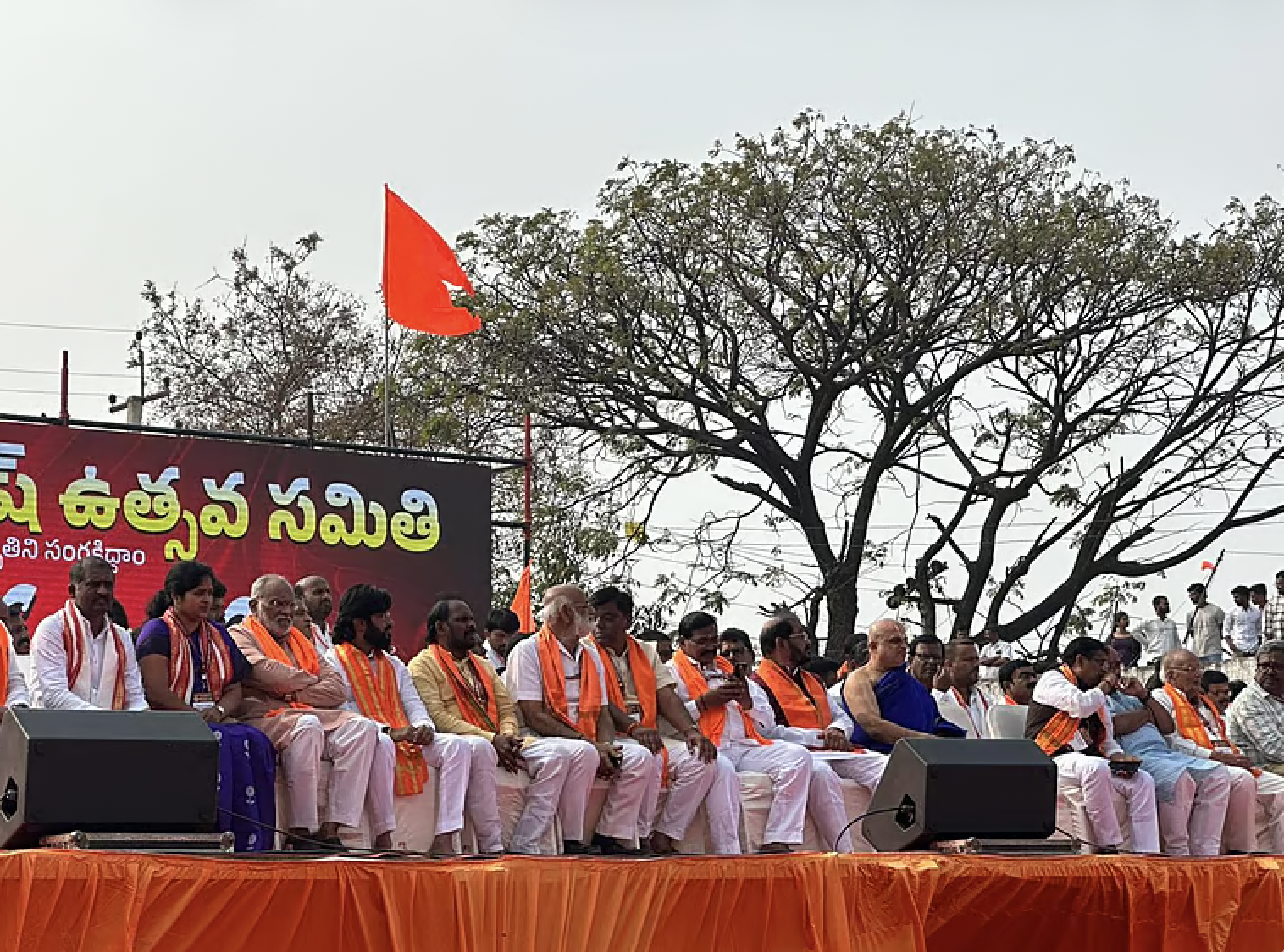
Two days before India celebrates Republic Day to commemorate its Constitution, a conclave held in Hyderabad on January 24, under the banner of “Dharma Rakshana Sabha”, offered a stark glimpse into how coded rhetoric against minorities can rapidly slip into explicit calls for violence.
Organised by the Ganesh Utsav Committee, an organisation affiliated with the Rashtriya Swayamsevak Sangh (RSS), the gathering in Balapur, a place in Hyderabad where many Rohingya Muslims live in camps, drew a large crowd clad in saffron scarves and waving saffron flags.
While the event’s stated intent was to protect “dharma” and oppose Rohingya refugees and alleged Bangladeshi migrants, the speeches steadily escalated from insinuations about national security and “love jihad” to direct incitement against the Muslim community.
The turning point in the four-hour event came when chief speaker Girdhar Swami Shastri declared that he would not step down from the dais until India was converted into a Hindu Rashtra. The earlier disclaimers about not targeting any “caste, creed, and religion”, seemingly to avoid legal troubles, had collapsed entirely. The conclave had moved from dog-whistling to an outright rejection of the rule of law.
In a series of provocative assertions, Shastri claimed that Muslims enter other countries “either to convert or to behead” non-Muslims, adding that this was in line with their religious teachings. “Until the Quran exists, there can be no peace in this world,” he said, calling the Quran and mosques the root cause of what he described as invasion and infiltration. Dismissing secularism outright, he said the idea that all religions are equal was false and dangerous.
Referring to Rohingya Muslims as “infiltrators” bent on spreading jihad, he made sweeping claims about Islam, repeatedly portraying Muslims as inherently violent and disloyal.
Balapur, which hosts a settlement of Rohingyas who fled religious persecution in Myanmar, became the symbolic backdrop for this rhetoric. The Indian government does not categorise Rohingya Muslims as refugees and therefore they are considered “illegal immigrants”. As per government records, Balapur has 6,993 Rohingyas.
This story was originally published in thenewsminute.com. Read the full story here.