
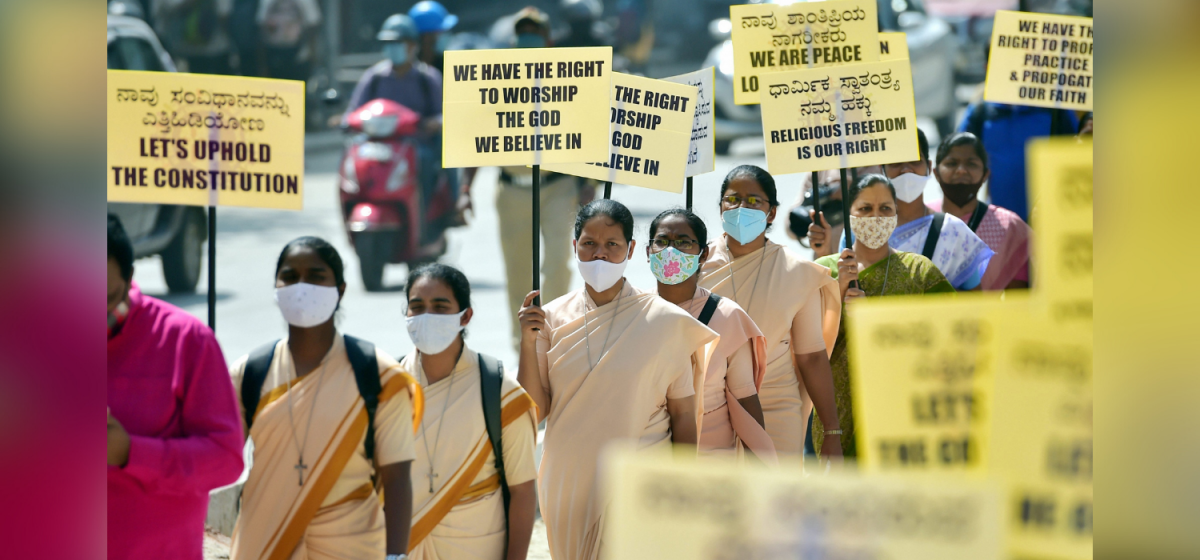
Before the Chhattisgarh government brought the ‘Freedom of Religion Bill’ (sic!), among the strictest anti-conversion law to date, twelve states in India already have such a law in one form or the other. Indeed, it is named ‘Freedom of Religion’ to brow-beat the constitutional questions, but none of these laws have anything to do with ‘freedom’. These overhyped laws deserve to be juxtaposed with the letter and spirit of the Constitution to raise the question as to why the judiciary as the guardian of the Constitution of India has not reacted against them.
The laws
Aiming to outlaw conversions from Hinduism to religions other than Sikhism, Buddhism and Jainism, all the laws in different states create provisions against use of force or coercion (psychological pressure, physical force, threats and even social boycott and misrepresentation leading to marriage by fraudulent means), applying undue influence through allurement (monetary benefits, gifts, employment, free education or medical facilities, promises of a better lifestyle, or marriage). The laws, which focus mainly against conversion to Islam and Christianity, prescribe tough penalties in all the states; each subsequent ones are even tougher. The laws bar any person from directly or indirectly promoting or conspiring to convert another person through such illegal means.
General violations under these Acts may attract imprisonment of not less than seven years, extendable to 10 years. A minimum fine of Rs 5 lakh is also recommended. In cases involving minors, women, persons with mental disabilities, or members of Scheduled Castes, Scheduled Tribes or Other Backward Classes, punishment may range from 10 to 20 years’ imprisonment with a minimum fine of Rs 10 lakh. Viewed more strictly, mass conversions may lead to imprisonment of up to 10 years, even life. Minimum fine of Rs 25 lakh and/or life imprisonment is recommended for repeat offenders. In case public servants are found guilty, they can be punished with 10 to 20 years of imprisonment and a minimum fine of Rs 10 lakh.
A careful study of the laws indicate that loose and ambiguous phrasing of the rules leave a large space for misuse by the enforcement agencies both suo motu and on political directive, but more than them by the vigilantes belonging to Bajrang Dal, Vishwa Hindu Parishad, et al to harass the minorities. Any non-Hindu institution or group making provision for a free clinic, a scholarship, even a friendly prayer meeting comes under scrutiny and legal and illegal harassment follow.
Several cases of a Hindu nationalist group filing complaints and police acting quickly despite weak or non-existent proof have been noticed. Given low conviction rate arrests, court cases, and violence spoil the social harmony. The laws have appeared to become a tool not to stop conversion, but to scare the minorities. No wonder, Chhattisgarh Christian leaders have raised concerns that a ‘strict’ anti-conversion law that has replaced the 1968 legislation aims to target Christians and other religious minorities.
Constitutionally Speaking
This genuinely raises questions on the constitutional validity of such laws. It further questions as to why their constitutional anomalies have not been challenged in a court of law. Since the actions relating to them have gone to the courts at all the levels, why the judiciary has not gone into their legitimacy.
This story was originally published in thewire.in. Read the full story here.