
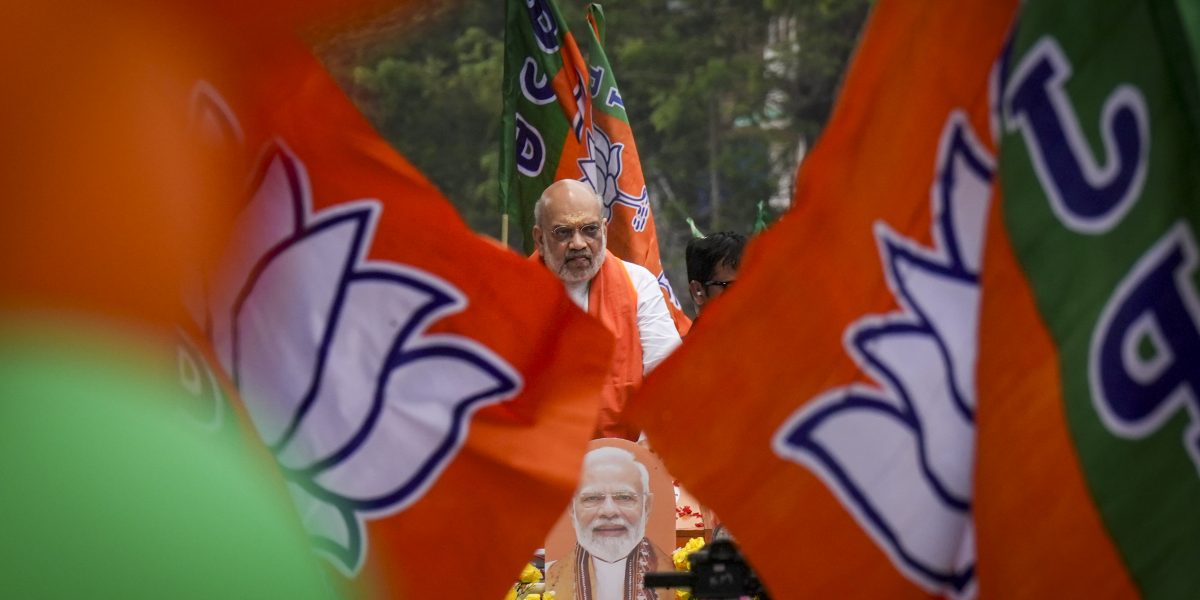
Historians have an inbuilt defence mechanism. Since they know that every history has history, they are surprise-proof. The West Bengal election results which have gone hugely in favour of the Bharatiya Janata Party (BJP) may have upset many of them temporarily, but on reflection they have found themselves firmly footed. For them, Bengal has traditionally been an enigma, which has just once again been reconfirmed.
It was Bengal, from where the East India Company had started its Indian journey. The Mughals before them too had found the province interesting. Initially they encountered some difficulty to control it because of its wet cartography but in due course they took full advantage of the situation to build a prosperous rain-fed agricultural economy which helped them raise a massive standing army that was able to browbeat all contemporary Indian rulers. That the changing course of the Ganga in the previous hundred years came handy to them to take advantage of the situation is a long story.
During the hundred years of the East India Company rule (1757-1857) it was this province alone which was chosen for two important Hindu social reforms, one, the abolition of the Sati ritual, and two, the validation of widow remarriages. These reforms, however progressive, angered the Hindu conservatives, who had traditionally dominated the Bengali Hindu social order. This fact did not escape the notice of the politically suave British. They realised that since their business was business, they should scrupulously avoid interfering with the Hindu social norms.
Soon after the 1857 revolt when the British Crown supplanted the East India Company rule, their governing-bible was not to dirty their hands with the Hindu social practices however retrograde they were. They took the logic even further. Through systematic political manoeuvres, they sowed the seeds Hindu-Muslim discord which by the end of a few decades assumed monstrous proportions. It was no surprise that when Sir Syed Ahmed Khan was initiating a Muslim political and social awakening in the early twentieth century he identified the Bengali intelligentsia as his primary enemy.
It may be underlined that Bengal was the first breeding ground of Hindu nationalism. Even the idea of Hindutva originated there. It was not Vinayak Damodar Savarkar who had invented the word through his 1923 book Hindutva: Who is a Hindu? Which is commonly believed. The idea was developed by a Bengali, Chandranath Basu (1844-1919). He wrote a book in Bengali in 1892 called: Hindutva: Hindur Prakita Itihas (the true history of the Hindus). Even much prior to that, in 1858, another Bengali, Tarinicharan Chattopadhyay, had written Bharatbarsher Itihas (the history of India), which was out-and-out a Hindu chauvinistic-nationalistic statement spouting venom at everything Muslim.
From 1867, an annual event called Hindu Mela had been institutionalised in Bengal to which Bengali Bhadralok flocked in large numbers. The Bhadralok is a complicated concept which can be summarily understood as representative of the upper caste Bengalis consisting primarily of the Brahmins, Baidyas and the Kayasthas, the literati of Bengal in general. (One can entertainingly remember them as KABAB – KA for Kayastha, BA for Baman (Brahmin), and B for Boddi, or Baidya.) Started by Nabagopal Mitra, its initial financier was the Tagore family (six years after Rabindranath Tagore was born).
This story was originally published in thewire.in. Read the full story here.