
By Kunal Purohit and Aashna Ajmera
Mumbai/Nagpur: In April this year, days before Nandigram in West Bengal went to polls, Bharatiya Janata Party (BJP) leader and the face of the party’s campaign in West Bengal, Suvendu Adhikari travelled to the constituency.
Speaking to voters, he rattled off facts.
Thirty thousand locals from Nandigram, he said, worked as migrant workers in different states of India. Then, he went on to spell out the Muslims among them.
“There are over 30,000 migrant workers…in Gujarat, 1,100 Muslim men from Nandigram reside. In Odisha, 800 Muslim men reside. In Maharashtra, 3,300 Muslim young men reside. Whose government is in Odisha? Whose government in Maharashtra? Whose government in Gujarat?” he asked.
Singling out Muslims, he issued a warning. “Don’t make a mistake! Mend your ways… so that there are no problems after May 4 (the day of counting). You can give threatening looks and say ‘Joy Bangla’, but I am writing down everything,” he was quoted by The Times Of India as saying. Adhikari ended up winning the seat by 9,665 votes.
Such rhetoric by Adhikari isn’t an exception.
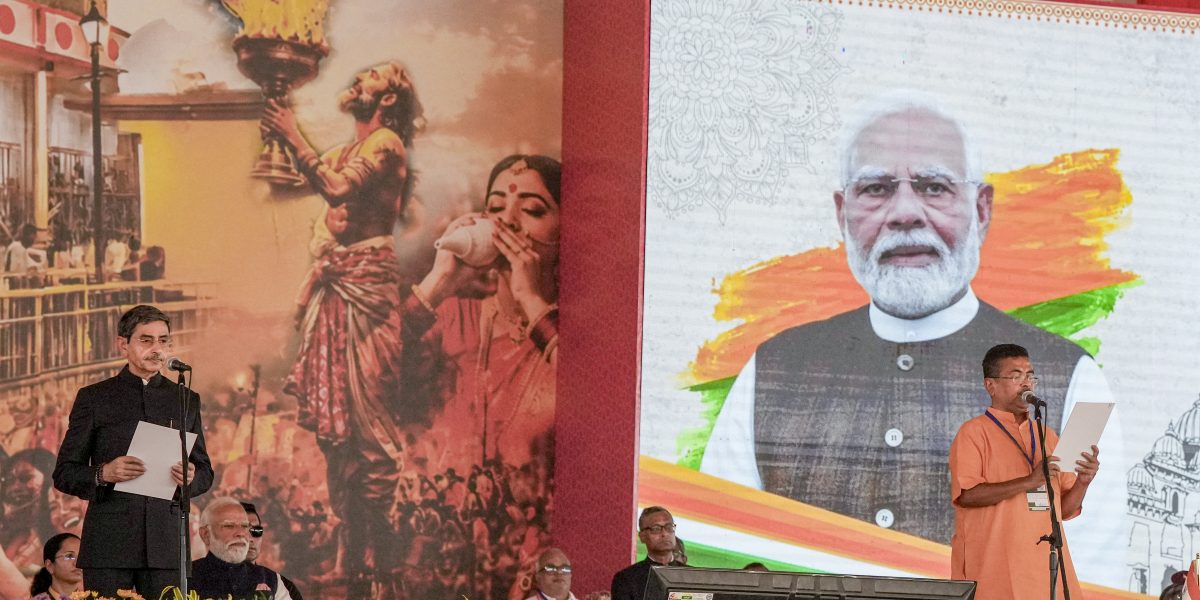
Over the last two years, as the BJP tried to make deeper inroads into West Bengal, culminating in its historic win on May 4, Adhikari led from the front and emerged as the face of the party. It was little surprise, therefore, that Adhikari has been sworn in as the BJP’s first chief minister in the state.
But an analysis of Adhikari’s public rhetoric, since he switched over to the BJP from the Trinamool Congress (TMC) in December 2020, shows a systematic pattern of targeting the state’s Muslim population – inciting hate against them, peddling conspiracy theories and advocating their social boycott.
This story was originally published in thewire.in. Read the full story here.