
The Narendra Modi government frequently posits India as a ‘Vishwaguru’ or world leader. How the world sees India is often lost in this branding exercise.
Outside India, global voices are monitoring and critiquing human rights violations in India and the rise of Hindutva. We present here monthly highlights of what a range of actors – from UN experts and civil society groups to international media and parliamentarians of many countries – are saying about the state of India’s democracy.
Read the monthly roundup for August 1-31, 2026.
International media reports
Financial Times, UK, August 7
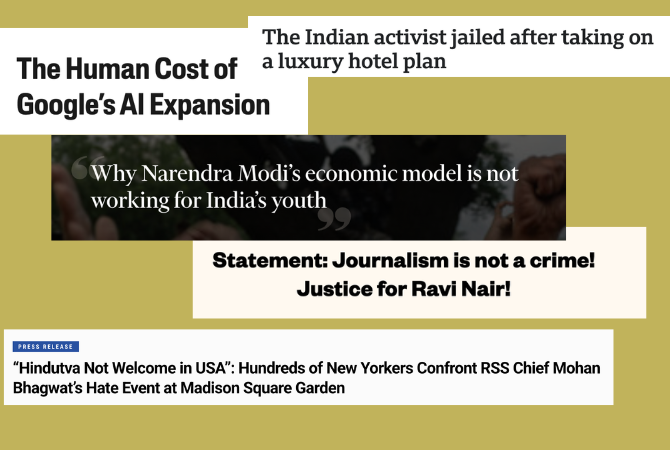
Michael Stott describes structural problems plaguing the Indian economy which underlay “the wave of youth malaise” behind the recent protests, reflecting “deeper problems with India’s growth model”. These range from unemployment or under-employment of India’s youth, hurried policies like demonetisation and GST, to extreme cronyism, and loss of investor confidence due to failed rule of law.
Jacobin, US, August 12
Anuj Behal illustrates the implications of the Andhra Pradesh government’s decision to build a large Google AI data centre. Land is being forcibly acquired from Dalit and small landholding families “being paid a fraction of what the land is actually worth”. Water and electricity needs are akin to what a town or small city would need. Despite these demands, Behal reveals that data centres are being treated as “conventional construction projects” enabling state-level appraisal processes which cut down public consultation.
BBC, UK, August 18
Zoya Mateen and Dilip Kumar Sharma report on the incarceration of Pranab Doley, an indigenous rights activist from Assam. Doley was arrested after joining a protest against a planned luxury hotel near Kaziranga National Park which threatens land rights and conservation in the area. The Assam government invoked a preventive detention law – the National Security Act – after Doley was granted bail, keeping him in custody.
Indian diaspora and international civil society groups
South Asia Solidarity Group held an online panel discussion titled Students Fighting Fascism: What Lies Ahead? with writer Arundhati Roy, Neha Bora (President of the All-India Student’s Association of India, AISA), Danish Ali (Jawaharlal Nehru University Students Union (JNUSU) Joint Secretary) and Anant Gupta (journalist) on August 9, focussing on the recent student and youth-led protests at Jantar Mantar in Delhi.
South Asia Solidarity Group held the second session of their webinar series, The Resistible Rise of Adani, to discuss “the deeper links between imperialism, global finance capital and the Modi-Adani regime” on August 15. The conversation “examines the processes through which Western financial institutions and investors are getting rich off Modi’s economic model which is transferring India’s public sector infrastructure into the private hands of Adani.”
This story was originally published in thewire.in. Read the full story here.