


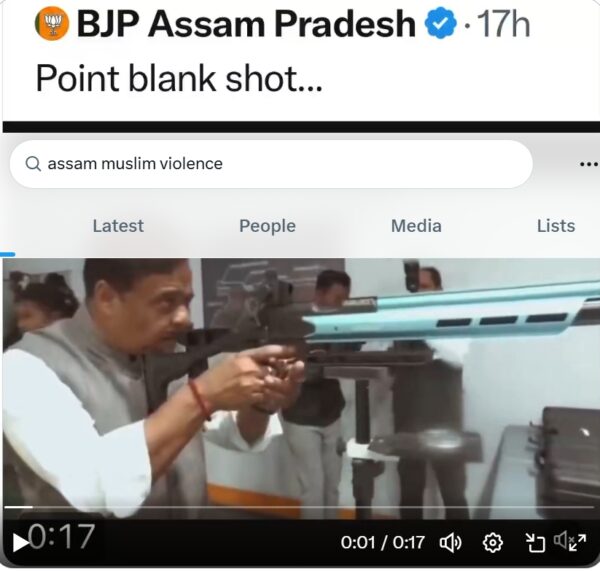
Credit: X/Supriya Shrinate
Anti-Muslim violence in India is not a recent phenomenon. However, since 2014, when the Hindu nationalist Bharatiya Janata Party (BJP) came to power with a strong mandate, the systematic and widespread targeting of Muslims, India’s largest religious minority, has assumed alarming proportions. Muslims are being beaten and lynched. Their homes and shops are being bulldozed and their livelihoods destroyed. Their way of living, cultural and religious practices are being systematically undermined. Muslims are routinely dehumanized even by top political leaders, who publicly incite violence against them. Laws have been enacted to strip Muslims of their Indian citizenship.
Worryingly, the violent, widespread, and systematic targeting of Muslims is being orchestrated with the active support of state institutions. As the recently released Report of The Panel of Independent International Experts to Examine Information About Alleged Violations of International Law Committed Against Muslims in Assam and Uttar Pradesh, India—2022–25 noted, there is “credible evidence of widespread and systematic human rights violations against Muslims, and reasonable grounds to believe that international crimes, including persecution, torture, and deportation as crimes against humanity, may have been committed.” The study, which focused on the situation in Uttar Pradesh and Assam, pointed out that the chief ministers of these two states could be preparing the ground for ethnic cleansing.
Stephen Rapp, one of the three members of the Panel that carried out this study, told The Diplomat’s South Asia editor, Sudha Ramachandran, that the hate speech and persecution of Muslims may amount to a crime against humanity. A former chief of prosecutions at the International Criminal Tribunal for Rwanda; chief prosecutor at the Special Court for Sierra Leone; and former U.S. Ambassador-at-Large for War Crimes Issues, Rapp drew attention to the “normalization of anti-Muslim violence in India, where everyday violence and open calls to violence have become routinized.” India can draw lessons from the Balkans, he said, where “the descent into mass violence” began not with the war but with “narratives, and with the gradual normalization of the idea that coexistence was no longer viable.”
The report says that persecution of Muslims in the states of Assam and Uttar Pradesh may constitute apartheid, preparation for ethnic cleansing, and crimes against humanity. Could you throw light on the situation in these two states?
From the material we have examined, Assam and Uttar Pradesh have witnessed the most serious abuses by state actors. These include extrajudicial killings, arbitrary arrests and detentions, and torture and ill-treatment of Muslims. Across these states, authorities are also reported to be resorting to various reprisals as collective punishment against minorities and dissenters, on various pretexts. These states are also the hotbeds of anti-minority incitement and violence, with Hindu militant groups aligned to India’s ruling Bharatiya Janata Party (BJP) — including groups such as the Rashtriya Swayamsevak Sangh (RSS), recently recommended for sanctions by USCIRF, and its affiliates, Vishwa Hindu Parishad (World Hindu Congress) and Bajrang Dal (the Army of Hanuman) and various “cow protection” gangs — holding much sway and working in tandem with local authorities to target Muslims and other minorities.
Uttar Pradesh has been ruled by the BJP since 2017. Its government is led by Chief Minister Yogi Adityanath, a Hindu supremacist and a monk, who has a long history of anti-Muslim baiting, including inciting hate and violence, founding violent groups, and mobilizing Hindutva actors to target Muslims and other minorities. In Assam, it is again the state Chief Minister Himanta Biswa Sarma of the BJP, in power since 2021, who plays that role, having made anti-Muslim targeting the core of his polarizing politics.
This story was originally published in thediplomat.com. Read the full story here.