



The Election Commission of India’s (ECI) special intensive revision (SIR) in West Bengal has not produced one uniform pattern of deletion, but two. One runs through the Muslim-dominated border belt, where scrutiny through the ‘under adjudication’ process appears to be driving a large share of exclusions. The other runs through the urban and industrial belt, where deletion is being driven far more heavily through the draft-roll route. Together, they reveal a political and administrative operation that does not appear to be random.
Channels of exclusion
The total burden of deletion is spread across three channels:
- draft-roll deletions,
- deletions through the final roll under Form 7, and
- those marked ‘found not eligible’ under adjudication.
Statewide, draft-roll deletion has been the biggest channel of exclusion. But the second largest is channel three – ‘found not eligible’ after adjudication, and that is where the communal and geographic pattern begins to solidify.
This phase is also qualitatively different from the first stage of deletion. Those who were in the list of those ‘found not eligible’ by judicial officers were not simply absent names, but living people who had entered the process, appeared before judicial officers, and were then struck off after failing to satisfy documentary linkage demands tied to the 2002 electoral roll. In this sense, theirs is not just a deletion but an adjudicated disenfranchisement.
Muslim population and the under-adjudication pipeline
The most striking trend is the link between the Muslim population and ‘under adjudication’ scrutiny.
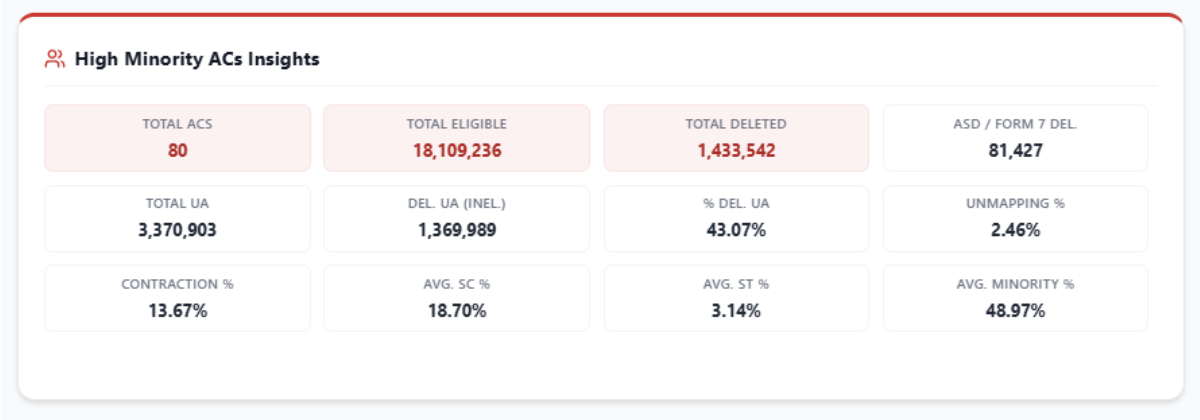
Constituencies with a higher Muslim population show a strong positive relationship with the share of voters pulled into the ‘under adjudication’ process. The same seats also show a strong rise in the number ultimately marked ‘found not eligible’ under adjudication. In plain terms, the more the population of Muslims in a constituency, the more likely it is to be dragged into the ‘under adjudication’ pipeline, and the more likely it is to see deletion through that route.
That pattern is one of the strongest relationships in the data.
This story was originally published in thewire.in. Read the full story here.