
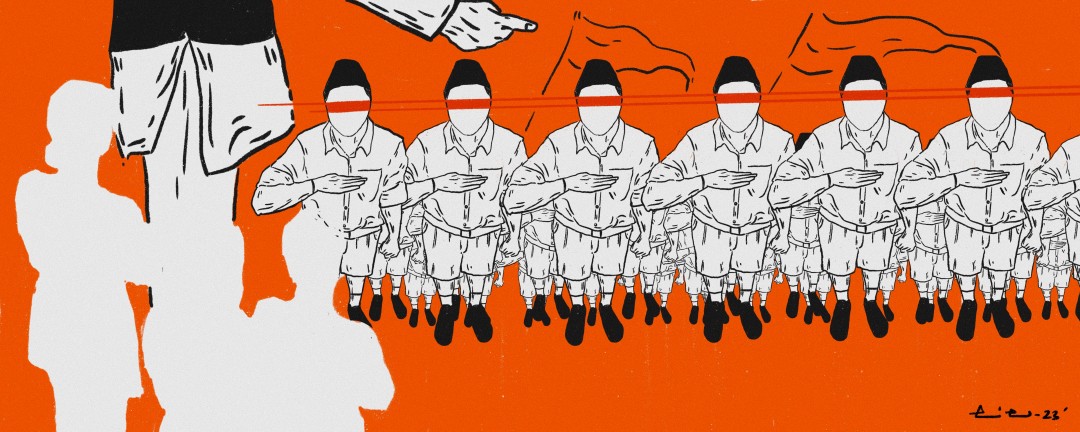
During the past hundred years, Hindu nationalists have amassed what is arguably the largest Right-ward apparatus to inflict the idea and architecture of an ultranationalist, majoritarian state on India.
Routed through society and culture, kinship, difference, revisionist history, ideology, morality, political economy and national identity, Hindu nationalism has built a massive cadre via the approbation of caste, religionisation, securitisation of borders and minoritisation.
Manoeuvring social control through marginalisation, mobilisation and exclusion, the onset of majoritarianism in the decades when Hindu nationalists were not in elected office was bolstered by political conflict and iniquitous governance. This led to the eventual consolidation of state power by the Hindu Right in 2014, officiated by Narendra Modi.
Hindu nationalism’s history predates South Asia’s decolonisation from British rule and India’s inception as a nation-state in 1947. In 1915, the Akhil Bharatiya (All India) Hindu Mahasabha (great assembly) was formed to integrate Hindus differentiated by place, history, language and culture, and generate antipathy to the Muslim League, as well as the Indian National Congress.
The conceptual, doctrinal and devotional premise of Hindu nationalism was to configure “Hinduness,” or Hindutva (Hindu Tatva or principles), defined in 1923 by Vinayak Damodar Savarkar, a founding figure of the Hindu Mahasabha. In a pamphlet entitled “Hindutva,” Savarkar stated: “Hindutva is not a word but a history”.
To administer Hinduness, an array of organisations emerged in the past hundred years, known as the Sangh Parivar, that comprise the Hindu nationalist “family.” By the 1940s, the Sangh Parivar exploded across what became “India,” operationalising centres and community induction via its ideology and practices, including in conflict areas such as Assam and in the neo/colonial administration of Kashmir.
Principal organisations of the Sangh Parivar maintain offices nationwide, each totalling between a few dozen and hundreds of branches. Supreme among them is the Rashtriya Swayamsevak Sangh (RSS, National Volunteers Association), of which Modi is a flagbearer.
The RSS, founded in Nagpur in 1925, is Hindutva’s ideological and cultural core, together with the Vishva Hindu Parishad (VHP), instituted in Mumbai in 1964. The Bharatiya Janata Party (BJP), the parliamentary fulcrum, was formally created in 1980.
The cadre of the Sangh Parivar reportedly numbers between 50 and 70 million persons at present. Its workers and volunteers are affiliated with one or more of its organisations. Extensive recruitment and training of youth and members take place in vast swathes of the country encompassing rural and urban areas and peri-urban zones. Members who are inducted into special units receive training in leadership, grassroots mobilisation and violent agitation and armed action.
This story was originally published in thewire.in. Read the full story here.