


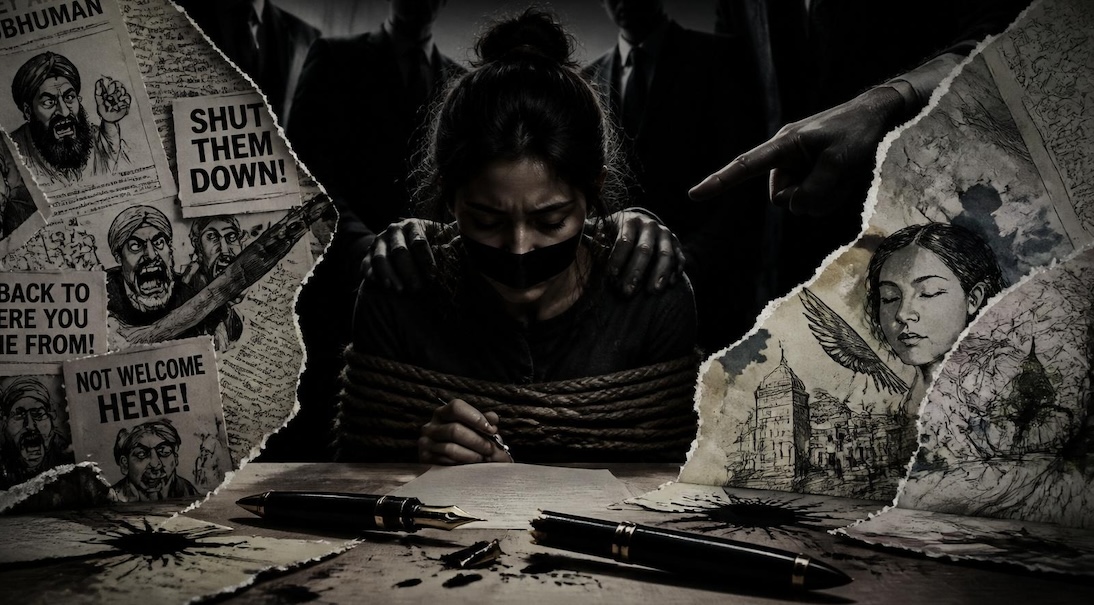
By Yunus Ali
“Expressing my thoughts the way I truly want to has never been easy for me, precisely because I am both a Muslim and a political cartoonist.”
These are the words of cartoonist Sameer Akhtar Shaikh, written in an article published on the website of Outlook magazine. He describes living with a constant sense of fear before expressing any opinion, a fear he believes is shaped and reinforced by the state itself. In his view, the state is especially uncomfortable with Muslim political cartoonists because they are often more attuned to, and outspoken about, the discrimination and violence faced by the Muslim community.
This fear is not unique to Sameer Akhtar Shaikh. It is shared by many Muslim cartoonists across India. More broadly, even cartoonists with secular views find it increasingly difficult to work freely if they choose to question or criticize the government. As a Muslim cartoonist myself, I live with the constant anxiety of wondering when, and on what pretext, I might become a target.
That is the harsh reality of India today: Muslim cartoonists are far more vulnerable to intimidation and retaliation than others. Before drawing cartoons about anti-Muslim violence, attacks by Hindutva groups, lynchings carried out in the name of cow protection, extrajudicial killings, the demolition of Muslim homes with bulldozers, or so-called “encounters,” one is forced to think repeatedly about the consequences.
Over time, artists begin censoring themselves. They change words, soften imagery, dilute satire, and sometimes abandon ideas altogether. They know that even the smallest detail can be weaponized to brand them “anti-national,” “anti-Hindu,” or “radical.”
As a result, many cartoons die before they are even drawn.
This is a form of undeclared censorship, and its most dangerous feature is precisely that it is unwritten. There are no official rules, no formal bans, no public declarations. Yet the fear is everywhere, shaping what artists say, draw, and ultimately dare to imagine.
There was a time when political cartoons in newspapers and magazines were seen as the heartbeat of democracy. Their purpose was simple: to challenge power, provoke debate, and hold governments accountable through satire.
This story was originally published in islamophobiamonitor.com. Read the full story here.