
By Rohit Varman
Excerpted with permission from The Politics of Corporations in ‘New’ India, published by Cambridge University Press.
The Sangh Parivar has garnered mass support by posing as anti-elite in its rhetoric. It is similar to the popular appeal of the Nazi Party that was based on their calls to overthrow the traditional German elite. As in other contexts, particularly the United States, the far-right movements funded by billionaires use the term ‘elite’ detached from economic status to label those fractions of the elite who oppose fascist imaginations. Hindutva’s popularity, similarly, hinges on its disavowal of a section of the elite constituted by liberal intellectual classes, including international non-governmental organizations and progressive media (derisively referred to as ‘Lutyens’ Delhi’), while maintaining cosy relationships with indigenous plutocrats and corporations. Thus, the rise of Hindutva is situated in its appeal to both the elite and lower classes. While the current Hindutva regime furthers the class interests of the more organized elite, it garners lower-class support through propaganda and doles such as free ration.
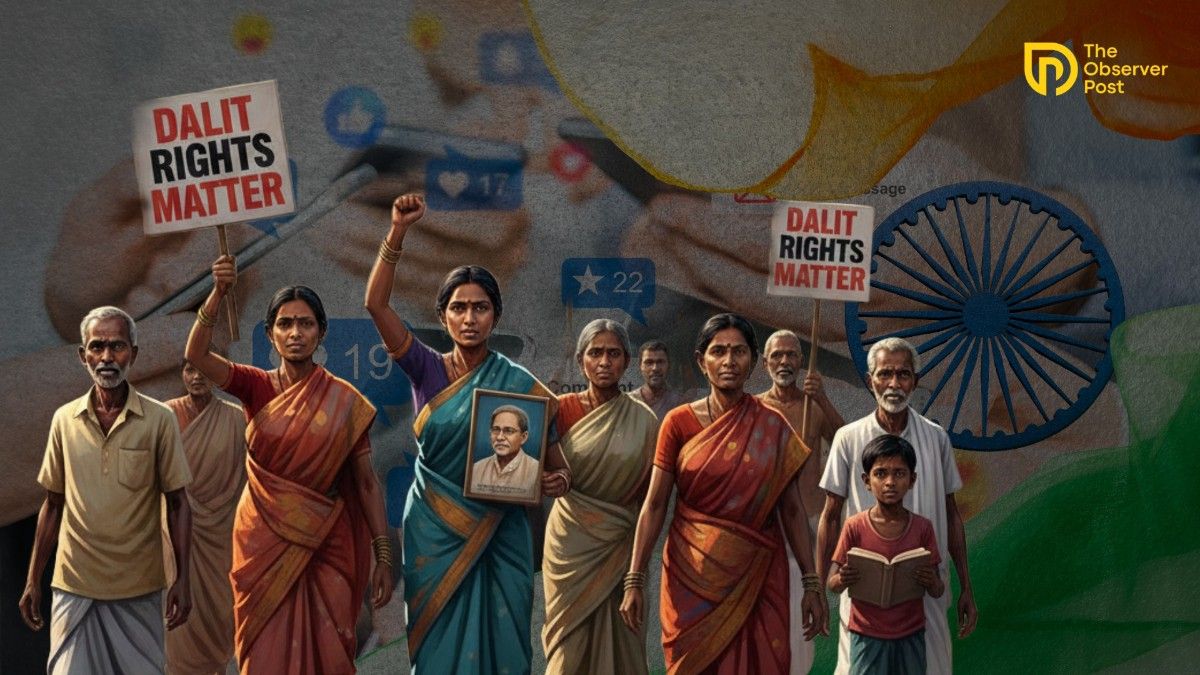
Arendt (1966) has argued that popular support for a fascist regime shows that people overlook their rights and material interests. We offer a more careful reading of such a formulation. In our interpretation of the dominance of Hindutva, we do not see lower classes overlooking their material conditions. Instead, abject poverty, caste inequities, patriarchy, and the absence of grassroots democracy limit the lower classes’ expectations of material gains to the minimal benefits doled out by the state (for example, the current offering of five kilograms of free food grain). The masses are, as J. Banaji (2016, p. 222) describes, in a state of ‘manipulated seriality’. Seriality is passive, inert, and dispersed people, not the behaviour of a cohesive group. Fascists work on serialities to produce desired outcomes. Thus, dispersed masses of people are susceptible to manipulations by organized groups. The control over the state apparatus furthers the dominance of the Sangh Parivar over disorganized masses reduced to individuals.
The politics of the RSS is fundamentally casteist, patriarchal, and anti-democratic (Kasbe 2019). The control over state apparatuses helps Hindutva reinforce the stranglehold of the highly organized big capital whose interests coincide with those of the upper classes and upper castes in society (Poruthiyil 2021). Modi’s record both as a chief minister of Gujarat and as the country’s prime minister suggests his governments have enabled the upper castes and classes to control Indian politics and have widened inequality (Jaffrelot 2021). The current regime has strengthened the stranglehold of the elite, and the new rulers are part of the Hindutva establishment elite that is structured and sustained by the cruel inequalities of power that Sangh’s anti-elite rhetoric rails against (S. Roy 2022). The ongoing control of the old elite reminds us that while fascist politics is monstrous and violent in newer ways, there is much that is unexceptional and routinized as well (Patnaik 2023b).
In sustaining the Hindutva propaganda, corporate media houses have played a crucial role (Naqvi 2019). The current Hindutva propaganda makes use of modern tools and deploys the tactics and vocabularies of anti-terrorism, anti-imperialism, digitization, and development, along with the older tropes of Hinduism present in paintings, calendar art, folk theatre, and cinema (S. Banaji 2018). Through a series of policies, this government has systematically constructed digital surveillance mechanisms by bringing streaming services into the ambit of censorship (Chisti 2023). These policies were supplemented by the vigilante mechanism of cyber and street activists and indiscriminate uses of penal provisions to criminalise content creators in the digital sphere (S. Banaji 2018). Control over these techniques of communication has turned Hindu rituals into muscular public–political spectacles that are used to threaten the other in the name of religion and nationalism. For instance, Hindutva forces make strategic use of popular music to spread their message (Purohit 2023).
Hindutva also uses monuments to further its messaging by repurposing the existing sites of cultural imagery and constructing new ones. The construction of the Ram Temple in Ayodhya on a site where a mosque existed for centuries is a prime example of such messaging. Another example is the Central Vista project that houses the Rashtrapati Bhawan, the parliament building, and other historically significant monuments. Activists and writers have noted that the execution of the Central Vista project is an attempt to re-sculpt Delhi along the contours of majoritarian Hindutva historiography (Appadurai 2021; A. Roy 2021). Such symbolism also includes the sphere of popular culture, and a cricket stadium in Ahmedabad has been renamed as Narendra Modi Stadium. A similar trend is visible in the renaming of cities and railway stations (for example, Allahabad to Prayagraj, Gurgaon to Gurugram, Mughalsarai Junction to Pandit Deen Dayal Upadhyaya Junction) as attempts to erase India’s Muslim heritage.
‘[F]ascists need a demonized enemy against which to mobilize followers’ (Paxton 2005, p. 17). In this, Hindutva’s othering of Muslims resembles the anti-Semitism of the Nazi Party. Hindutva is particularly insidious because it has been effective in deploying violent othering under the facade of nationalism, modernization, and democracy (J. Banaji 2016), and it does so by appropriating past prejudices and combining them with new ones ‘skilfully dressed up as old verities, and broadcasting the resultant compound through the most up-to-date media techniques’ (S. Sarkar 2016, p. 143). These conditions and strategies have helped the Sangh Parivar to recruit an army of stormtroopers, with Muslims being their prime targets (Jha 2017). The recent enactment of the Citizenship Amendment Act (CAA) is a prime example of a framing of Muslims that reduces them to second-class citizens. The act identifies Hindu, Buddhist, Jain, Christian, Sikh, and Zoroastrian as ‘persecuted minorities’, who arrived by 2014 from its Muslim-majority neighbours Afghanistan, Pakistan, and Bangladesh and are entitled to apply for citizenship. It omits Muslims, Jews, Bahais, and atheists from its purview, introducing a religious filter that violates the secular principles enshrined in the Indian Constitution (I. Roy 2022).
This story was originally published in thewire.in. Read the full story here.