


By Team
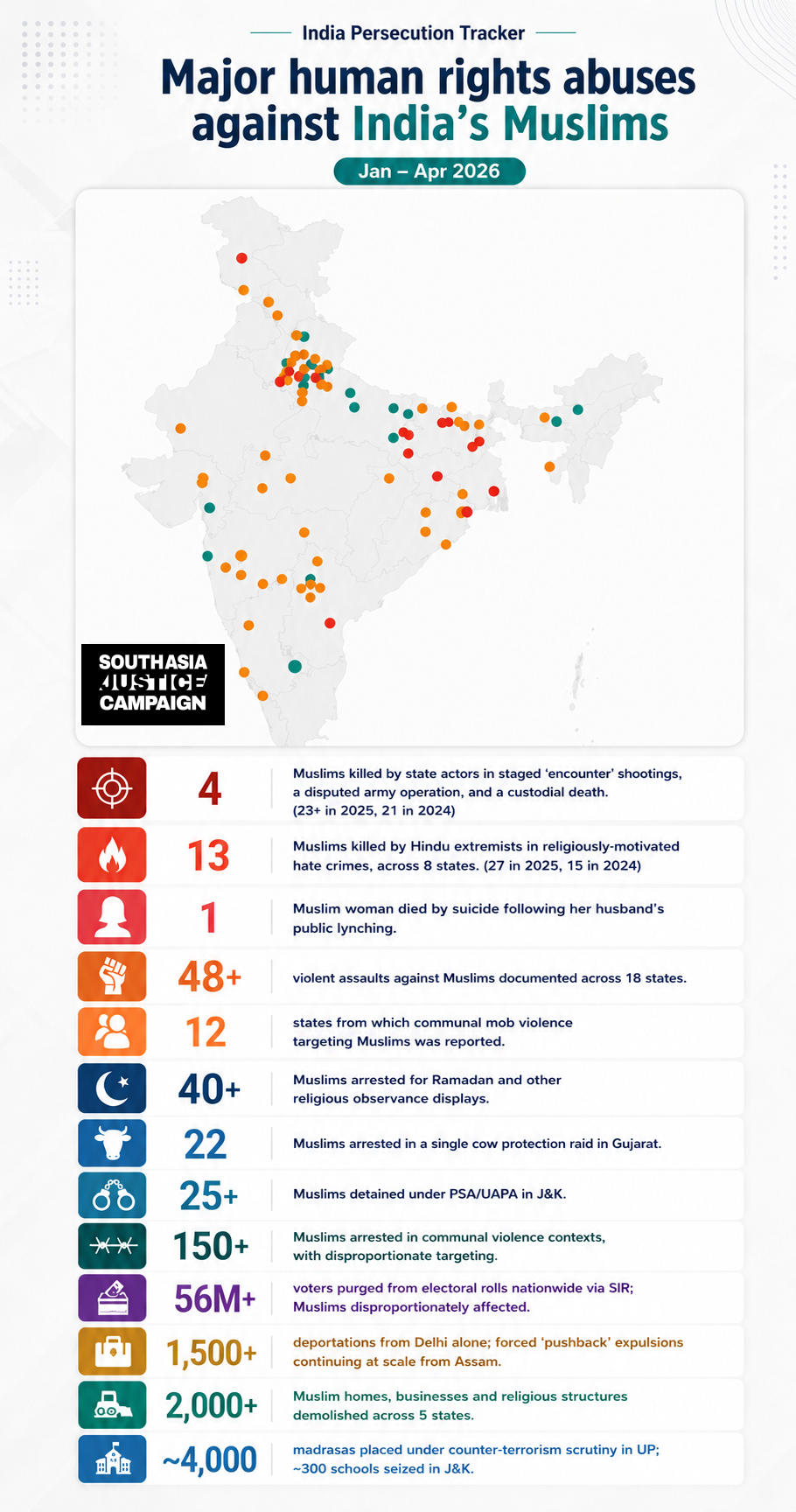
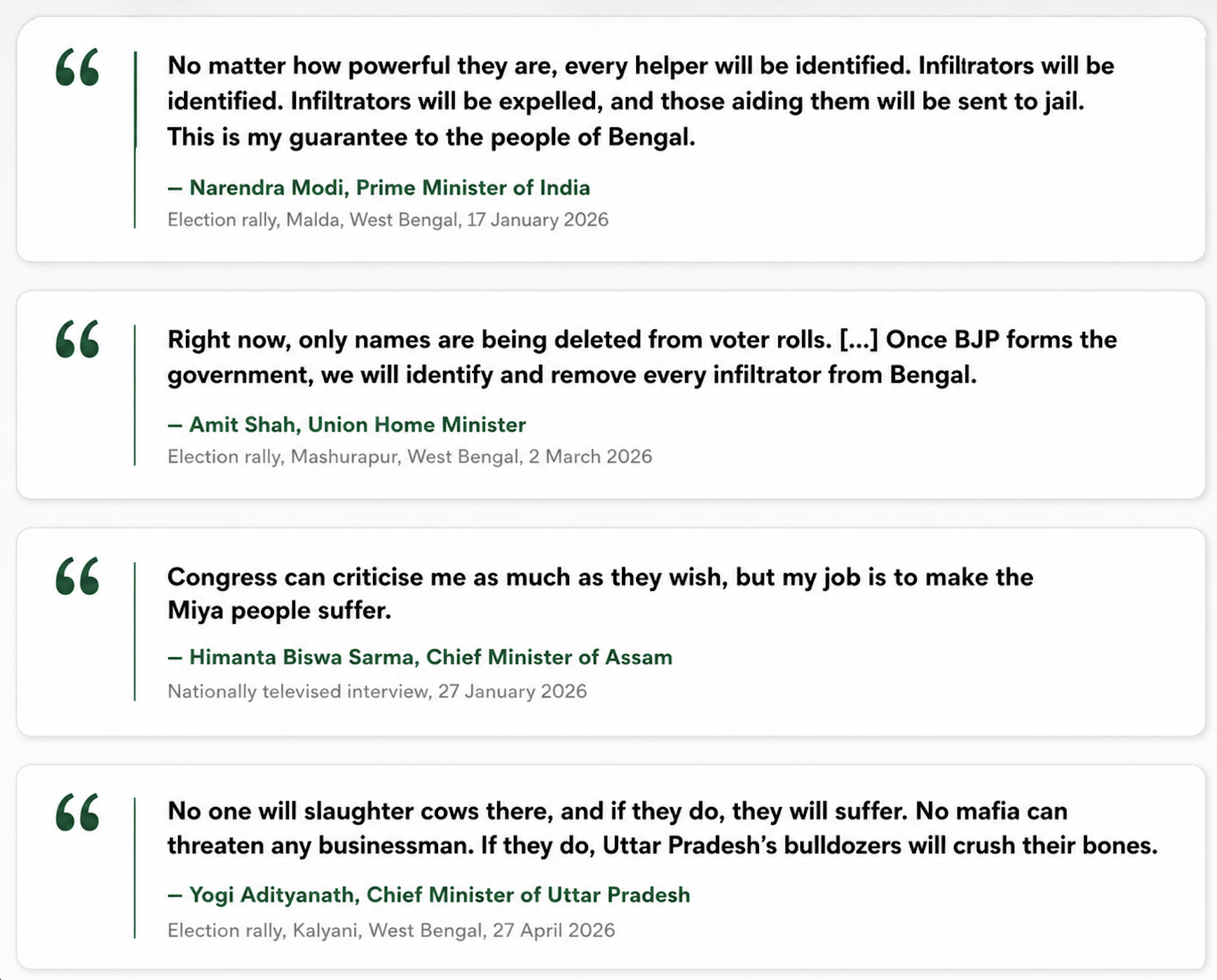
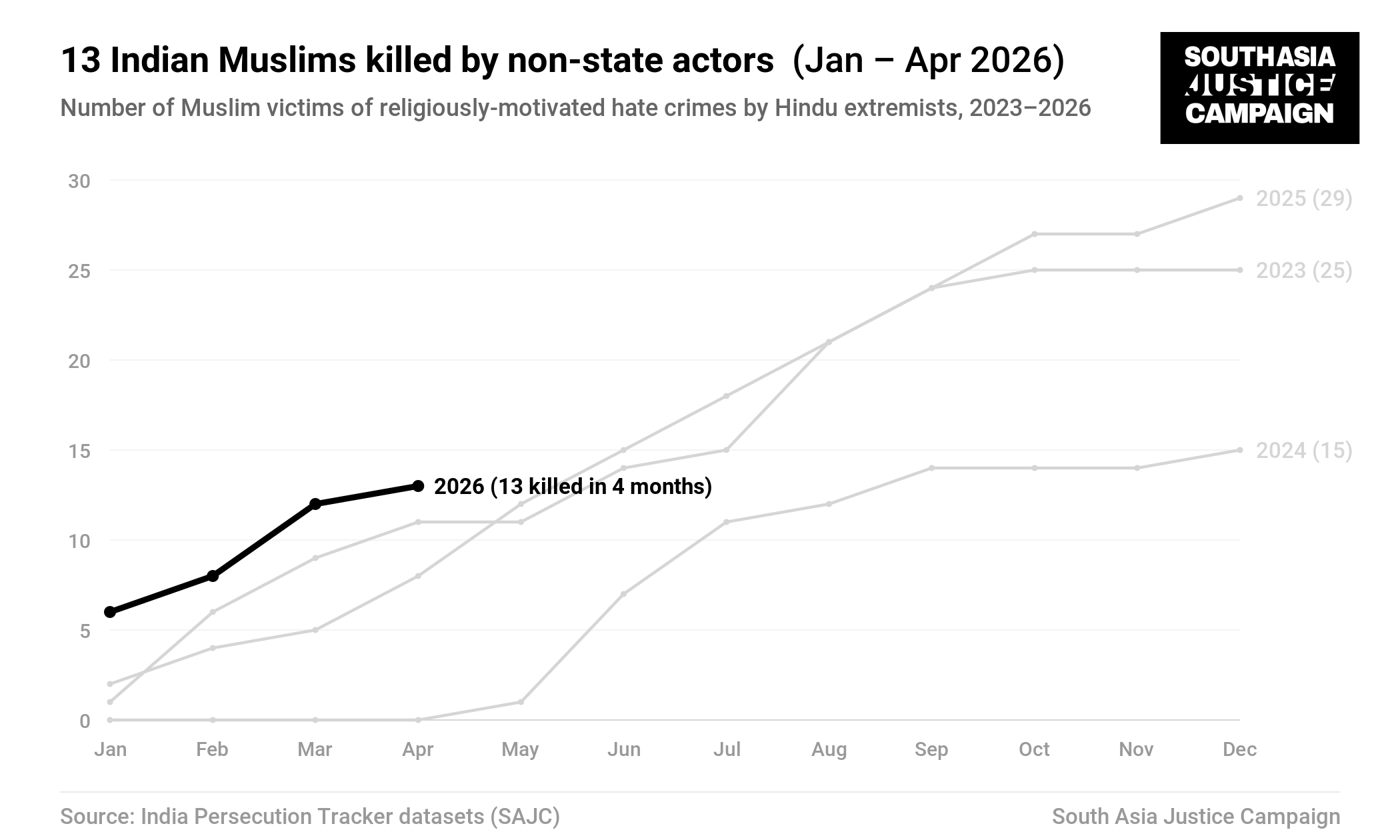
The first four months of 2026 culminated in what is likely to be the Hindu nationalist Bharatiya Janata Party (BJP)’s most consequential provincial election victory in India since it ascended to power at the federal level in 2014. In early May, as electoral authorities announced the results for polls held in four states and one Union Territory, the BJP emerged triumphant in West Bengal—an opposition bastion it had never won in its 46-year history—crushing the incumbent to secure over two-thirds of the state assembly. In neighbouring Assam, the BJP’s Chief Minister Himanta Biswa Sarma—who had publicly declared that his job is to make Muslims “suffer”—was also returned to power with a resounding majority. The BJP and its allies will now directly rule—at the central and state level—over 78% of India’s population, across 22 of 36 states and Union Territories.
The prelude to this staggering result—the period under review in this edition of the India Persecution Tracker, from January to April 2026—saw state actors continuing to deploy a long-documented and expanding repertoire of coercive practices against minorities, particularly Muslims, including by killing and maiming them in staged police “encounters”, and torturing and detaining them en masse. At election rallies across poll-bound states, India’s top political leadership—including Prime Minister Narendra Modi—continued to deploy dehumanising language against Muslims that did not merely incite hostility against them, but also worked to constitute them as a racialised outsider group: defined not by their conduct as individuals but by their descent, language, name, and habitation, and marked for identification, removal, and exclusion. As the Supreme Court watched on, India’s electoral authorities oversaw a systematic purging of over 56 million individuals from electoral rolls nationwide, with exclusion rates highest in Muslim-majority districts in West Bengal. Alongside, Muslim families across the country continued to have their homes, livelihoods, and places of worship bulldozed, their neighbourhoods rezoned into legally segregated enclaves, and their children’s schools seized or shut down—while many continued to be physically forced across the border at gunpoint, expelled by their own country and denied the right to return. The electorate’s resounding endorsement and rewarding of this programme of oppression signals its steady consolidation into something more permanent: a system of institutionalised domination, maintained through law, policy, and coercion—what international experts speaking to the situation in Assam, have concluded, constitutes apartheid.
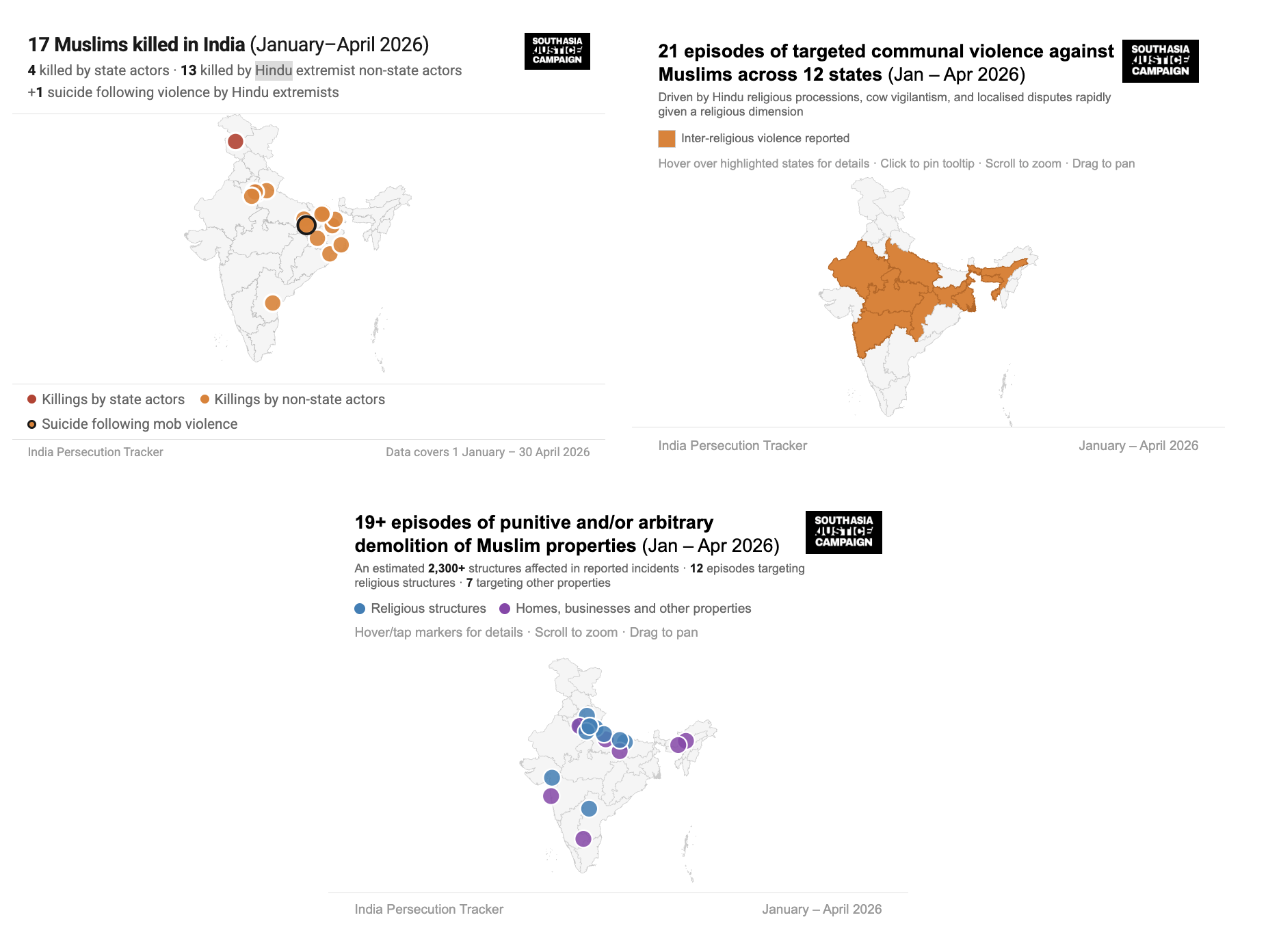
The incidents documented in this edition, covering the period from 1 January to 30 April 2026, are not exhaustive—they represent only those reported in the media and verified, a fraction of the total given the fast-shrinking space for independent reporting in India. Yet the patterns they reveal are themselves significant. A brief overview of the key findings:
- States ruled or controlled by the BJP —particularly Uttar Pradesh, Assam and Kashmir —continued to witness the most serious abuses by state actors, including extrajudicial killings, arbitrary arrests and detentions, and torture and ill-treatment. During the period, at least four Muslims were killed in incidents involving police, armed forces, or other state security personnel, including in staged ‘encounter’ shootings in Uttar Pradesh, a disputed army operation in Kashmir, and a custodial death in suspicious circumstances in Delhi. Authorities across multiple states continued to carry out widespread and arbitrary arrests of Muslims in numerous pretexts, while ‘half encounter’ shootings and custodial abuse by police continued in Uttar Pradesh despite recent rebukes from the state High Court and the United Nations, and border security personnel in Assam shot and critically injured two Bengali Muslim men.
Alongside, Manipur witnessed the return of inter-ethnic violence, with at least 15 fresh deaths, including of two children. See sections on: [Deprivation of Life — State Actors] [Arrests and Detentions] [Torture and Ill-Treatment — State Actors]
This story was originally published in southasiajusticecampaign.org. Read the full story here.