


Bengaluru: That an official communication from the country’s supposedly independent institution conducting supposedly free and fair elections would carry the seal of the ruling party is an indicator of two things: incompetence or complicity. In the case of India’s Election Commission, there is ample and growing evidence that it is guilty of both.
Issued on 19 March 2026, it was a routine letter, as you see below.
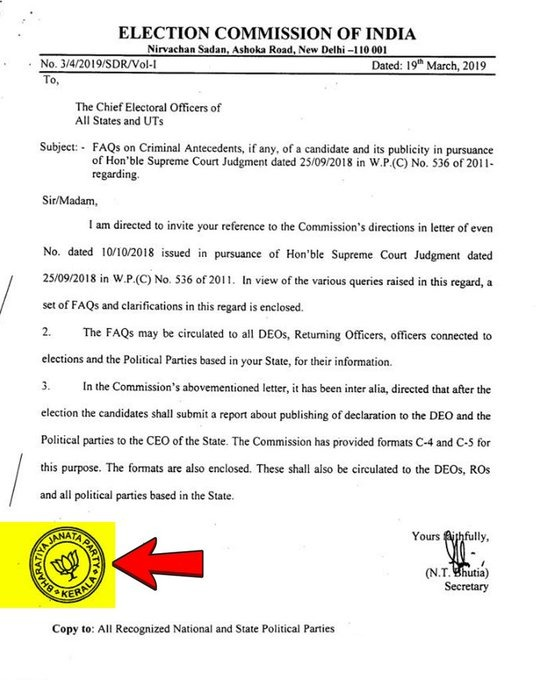
The incompetence is self-evident. The suspicions of complicity—hardly the first time—came because of the bumbling overreaction that followed.
Few bought the Election Commission’s “clarification” that the letter was “a clerical error”. Social media companies and hundreds of those who shared the letter received vague, misspelt threats from the police, who accused them of “abatement (sic)”—of what it wasn’t clear. The police claimed each post “blatantly insults” the Election Commission and “undermines communal harmony”.
Such made-up charges are, of course, par for the course in the Orwellian police state of Modi’s New India (where last week the police arrested and a magistrate denied bail to Muslims who broke their Ramzan fast by eating chicken biryani on a boat on the Ganga). Armed with ever-draconian powers, New Delhi now censors anything it does not like and is decentralising these powers: Any “officer specially authorised” can block a post, video or other online content.
For instance, a year after it was given the power to take down social-media content, a home ministry unit blocked 111,185 “suspicious online content”, according to the ministry’s latest report (page 281). There are no meaningful explanations given for “disabling of access to any information, data or communication link being used to commit an unlawful act”, or clarifying—as with the Election Commission’s attempt to censor its faux pas—what is unlawful about such content.
Designed To Fail?
As it turns out, the letter was merely a blip in a more ambitious project to dismantle the one-person-one-vote system by creating a subset of “unpersons”, as George Orwell termed persons who were vapourised in his book 1984, his dystopian prediction of times to come. M S Golwalkar, one of Hindutva’s leading ideologues, presented his vision of nationhood in 1939, arguing for a future in which minorities must “adopt the culture of the nation… or live at the mercy”.
This story was originally published in article-14.com. Read the full story here.