
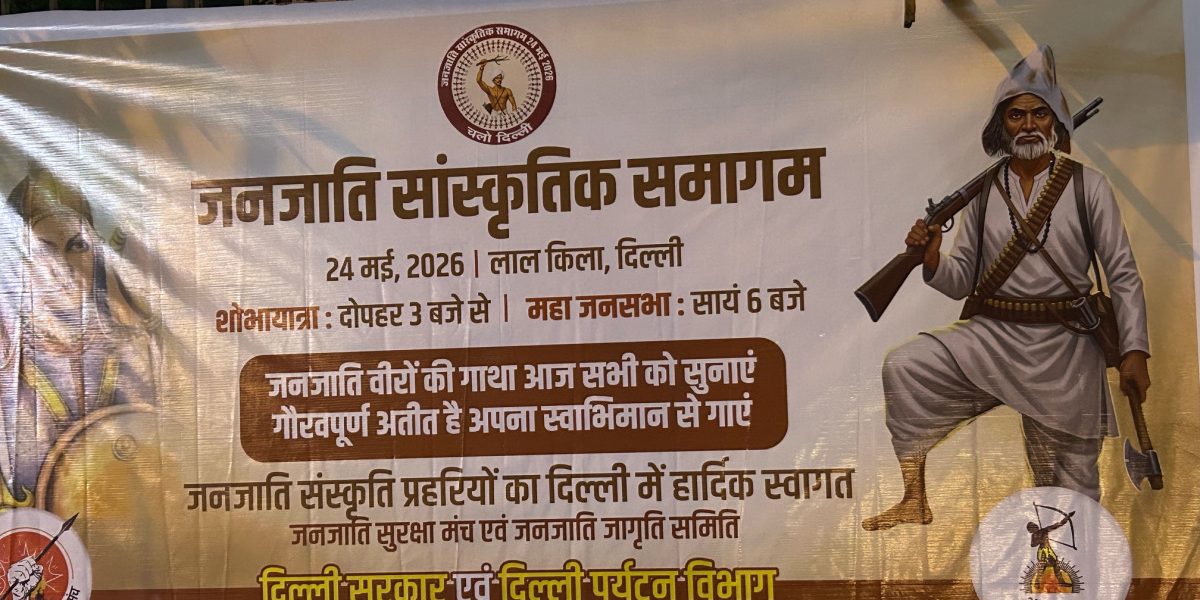
New Delhi: At least 72 Delhi government schools were used to house delegates attending a large tribal communities’ convention, ‘Janjati Sanskritik Samagam’, organised at the Red Fort on Sunday (May 24) by the Rashtriya Swayamsevak Sangh-affiliated Janjati Suraksha Manch (JSM) and Akhil Bharatiya Vanvasi Kalyan Ashram (ABVKA), and another NGO Janajati Jagriti Samiti. Union home minister Amit Shah was the chief speaker at the event.
The convention was held to commemorate the 150th birth anniversary of Adivasi icon Birsa Munda. Many Adivasi groups and activists had called for a boycott of the event, arguing that “the fundamental ideology underpinning this conclave is anti-Adivasi”. At the event, Shah referred to it as a “Janjatiya Mahakumbh”. ABVKA claimed that the event was attended by 1.5 lakh people from 550 tribal communities.
The JSM was formed in 2006 to oppose religious conversions among tribal communities, while the ABVKA has been working among tribal communities to “preserve their culture” and resist conversion to Christianity and Islam. Both are RSS-affiliated units and part of the larger Sangh parivar.
Those opposing the event have pointed out how these RSS-affiliated groups “consistently refrain from using the term ‘Adivasi’”, and instead describe tribal communities as “Janjatis” or “Vanvasis”. According to the signatories, these organisations view Adivasis as part of the Hindu social order and have promoted slogans such as “Sarna Sanatan Ek”.
An official communication issued by the Directorate of Education, accessed by The Wire, stated that the “Competent Authority has granted permission to Janjati Suraksha Manch for arranging accommodation facilities for delegates and guests from May 21 to May 25 in identified 72 schools”.
“The school premises shall be utilised strictly for the approved purpose and only for the specified duration,” the circular said, while directing heads of schools to extend necessary coordination and cooperation for the arrangements related to the event.
The order also specified that smart classrooms, laboratories and libraries were not to be used.
The order raised concern among teachers over the use of public school infrastructure for a privately organised, ideological event.
This story was originally published in thewire.in. Read the full story here.