
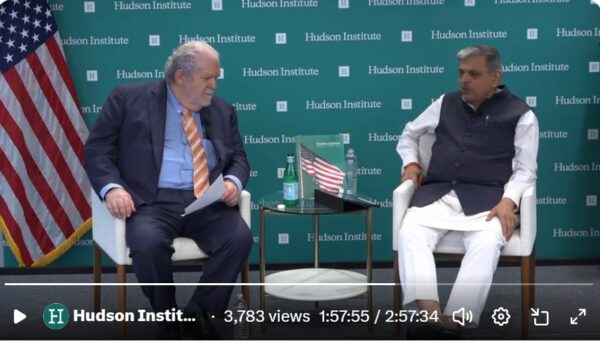
Credit: Screenshot/Hudson Institute Video
By Rushda Fathima Khan
On March 4 this year, the U.S. Commission on International Religious Freedom (USCIRF), a bipartisan, independent U.S. federal body, recommended for the first time that the State Department impose targeted sanctions on the Rashtriya Swayamsevak Sangh (RSS), the Hindu nationalist organization that serves as the ideological parent of India’s ruling Bharatiya Janata Party (BJP). The commission cited the RSS’ “responsibility and tolerance of severe violations of religious freedom,” and urged asset freezes and entry bans.
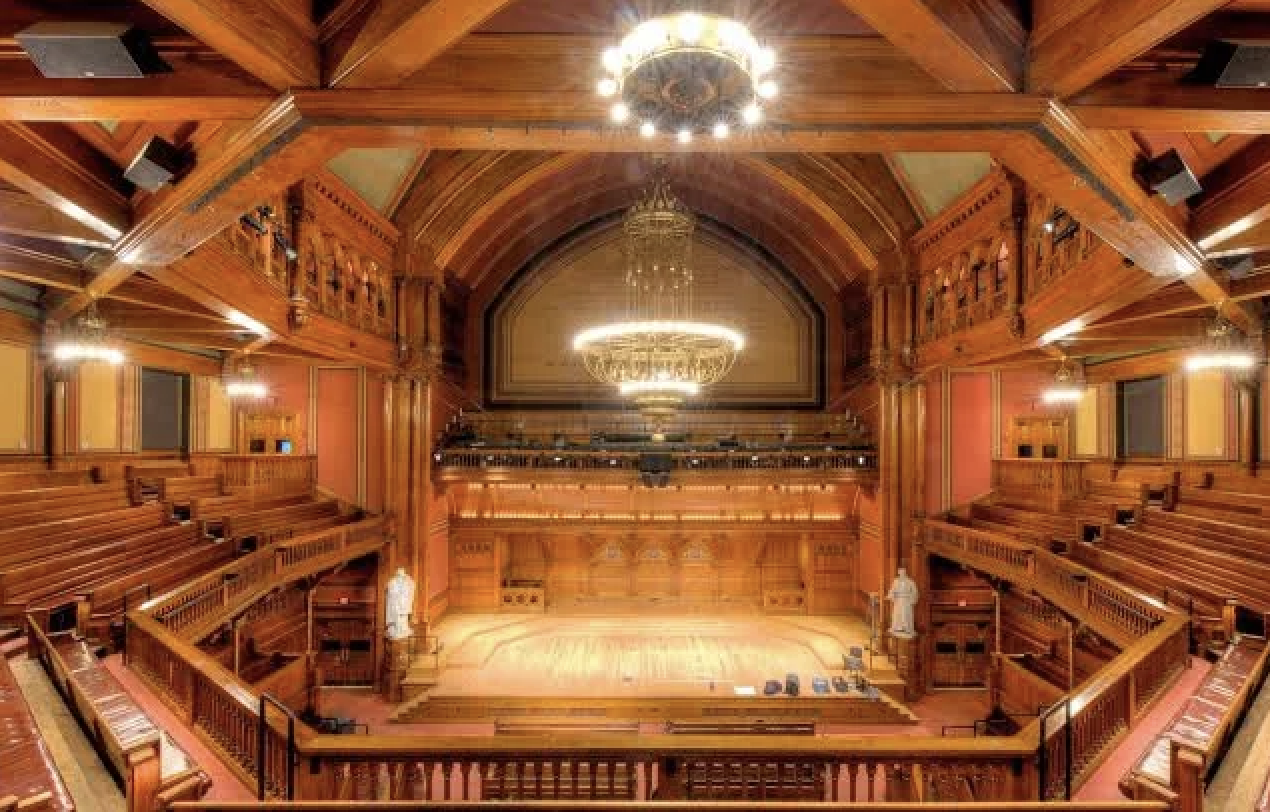
On April 23, RSS General Secretary Dattatreya Hosabale sat in a fireside chat at the Hudson Institute in Washington, hosted by the think tank’s fellow Walter Russell Mead. No one on stage raised the USCIRF recommendation, the documented record of anti-minority violence, or the RSS’s century-long ideological project. Before the Hudson appearance, Hosabale spoke at the THRIVE 2026 summit at Stanford alongside former National Security Adviser H.R. McMaster.
Hosabale’s swing through the U.S. in April was widely seen as an RSS effort at damage control. Facing arguably the most significant international rebuke in its history, the RSS launched its most ambitious Western outreach in its centenary year.
The Centenary Tour
Hosabale also toured the United Kingdom from April 10-15. In London, he addressed a Chatham House session billed as the “RSS View of the World,” attended a cross-party parliamentary dinner with Conservative, Labour, and Liberal Democrat parliamentarians, and held an academic roundtable with faculty from Oxford, UCL, SOAS, and other leading universities. He went on to visit Berlin on April 28, where he held discussions with German policy institutions.
Hosabale was candid about the purpose of his visits. He told reporters the RSS had “expanded its outreach to thinking and influencing sections, particularly the Western countries,” framing the tour as an effort to correct “misunderstandings” and “a lack of communication on the part of people from India.” It was an unusually frank admission from the organization’s second-in-command that the centenary tour was a coordinated bid to reshape how Western elites perceive the Sangh.
Rebranding Abroad
At the core of the RSS’s international messaging is a rebranding of the organization, which espouses a narrow Hindu supremacist ideology, to a benign civilizational movement rooted in ancient tradition. At Hudson, Hosabale rejected comparisons to the White supremacist Ku Klux Klan and insisted Hindu identity was “a civilizational identity, not a religious one.”
That framing sits uneasily against the RSS’s own domestic messaging. Months before the Western tour, Hosabale told a centenary gathering in Indore that “Hindutva, Hindu, and Hindu Rashtra collectively form the identity of Bharat.” In a centenary interview, when asked what the RSS had achieved over a hundred years, Hosabale said its impact had been Hindu nationalism and the cultivation of pride in India’s culture and civilizational values.
Audrey Truschke, professor of South Asian history at Rutgers University, told The Diplomat that the gap between the two messages is deliberate. “The RSS is a paramilitary organization dedicated to advancing Hindutva, a far-right political ideology,” she said. “Its mission and structure have not fundamentally changed during the duration of the group’s existence, roughly a century. What has changed is that the RSS now enjoys far-reaching influence in India… and so they are now seeking to misrepresent themselves as benign to Western audiences.”
Dr. Edward Anderson, a senior fellow at the School of Oriental and Asian Studies and assistant professor at Northumbria University, who coined the term “neo-Hindutva” in his book “Hindu Nationalism in the Indian Diaspora,” said Hosabale’s tour showed “the Sangh borrowing the language and methods of neo-Hindutva groups, entering spaces and adopting a register more familiar to NGOs and multicultural civil-society organizations.”
This story was originally published in thediplomat.com. Read the full story here.